Water Softener Size for a Meridian Home: How to Do the Math for Your Zone
To size a water softener for a Meridian home, multiply your zone's hardness in grains per gallon by your household's daily water use in gallons. That gives the grains the softener must remove each day. Then choose a unit whose capacity covers about a week of that load between regenerations.
The city's 2024 report puts hardness between 6.70 and 10.16 grains per gallon depending on zone, so two identical houses in different parts of Meridian can need different softeners. Here is how to work it out.
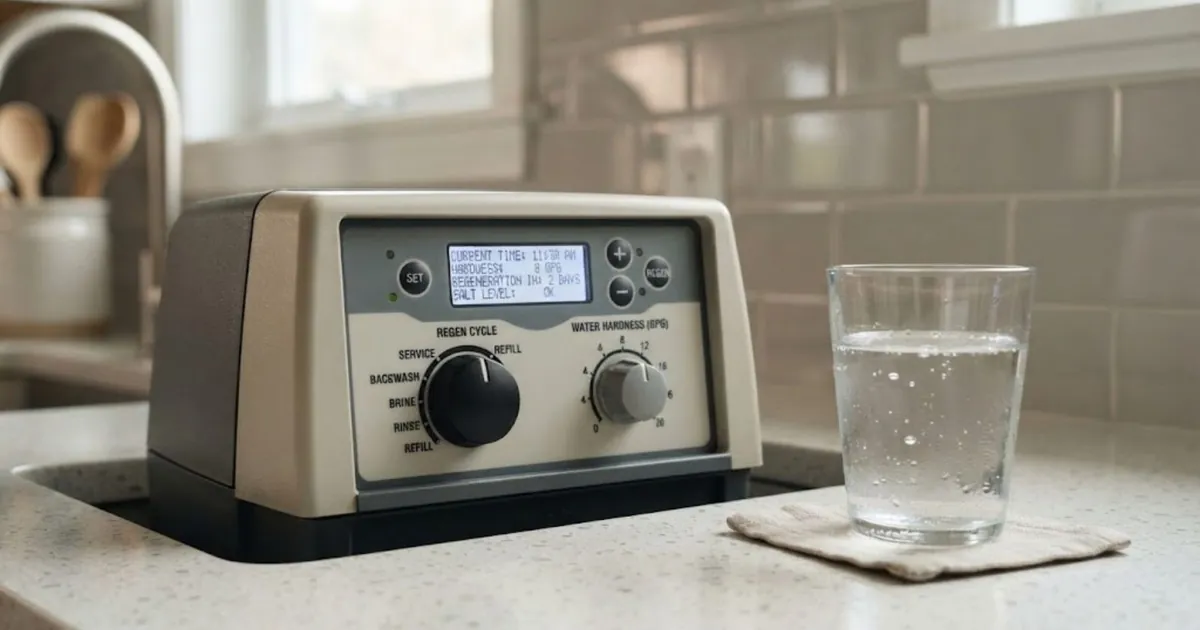
The three numbers you need
You can gather all three in a few minutes.
- Hardness: find your zone on the city's water quality map and use its grains per gallon figure.
- Daily use: a common estimate is about 75 gallons per person per day, or read two water bills and divide.
- Iron: the city's 2024 report lists iron from 0.00 to 0.23 mg/L by zone. Many sizing guides add hardness for iron, roughly 4 grains for each 1 mg/L.
If your home is on a private well rather than city water, test the well first. City reports do not apply to private wells.
Worked examples by zone
These examples use 75 gallons per person per day and the city's 2024 zone figures, with a small iron allowance where the report shows iron.
| Household | Zone and hardness | Daily grains removed | Weekly load |
|---|---|---|---|
| Two people, 150 gal/day | Zone 4, 6.70 gpg | About 1,000 | About 7,000. |
| Three people, 225 gal/day | Zone 2, 8.05 gpg (plus iron) | About 1,850 | About 13,000. |
| Four people, 300 gal/day | Zone 3, 8.70 gpg | About 2,600 | About 18,300. |
| Four people, 300 gal/day | Zone 1, 9.36 gpg (plus iron) | About 3,100 | About 21,700. |
| Five people, 375 gal/day | Zone 5, 10.16 gpg | About 3,800 | About 26,700. |
Illustrative math only. Your actual use and hardness decide the right size.
A softener's listed capacity, such as 32,000 or 48,000 grains, is usually its maximum at a heavy salt setting. Running it at a more efficient salt setting delivers less capacity, so the weekly load should fit comfortably inside the efficient setting, not the maximum.
Why bigger is not always better
An oversized softener regenerates less often, which sounds efficient. The problem is that resin sitting too long between regenerations can channel, letting some hard water slip through, and in homes with iron it can foul the resin faster.
An undersized softener has the opposite problem. It regenerates so often that it wastes salt and water, and on a heavy use day it can run out of capacity and pass hard water to the water heater.
The sweet spot for most households is a unit that regenerates every five to eight days at an efficient salt setting. The worked examples above put most Meridian families of three to five in the 32,000 to 48,000 grain range, adjusted for the specific model's efficient capacity.
Where the softener goes, and what it skips
The softener belongs on the main line after it enters the house, usually in the garage near the water heater. Outdoor spigots and sprinkler supplies are normally split off before the softener, since softened water is not needed for the lawn and wastes salt.
Many homeowners also leave a cold water line to the kitchen sink unsoftened, or add reverse osmosis there. Meridian's 2024 report already lists natural sodium from 16 to 79 mg/L by zone, and a salt-based softener adds a bit more. Our water filtration page covers reverse osmosis for drinking water.
Water conditioning equipment is permitted plumbing work in Idaho. A proper install includes a bypass valve, a drain line with an air gap, and a nearby outlet. Our water softener installation service handles the permit and sizing check.
If your water does not come from the City of Meridian
Some addresses near Meridian are served by other providers or by private wells. In Eagle, for example, homes may be on Veolia, the City of Eagle system, or a private well, and each has different hardness. The math is the same, but start with the right water report or a well test.
Salt settings and what they cost you
Every softener lets you set how much salt it uses per regeneration. A higher setting squeezes more capacity out of the resin but uses salt less efficiently. A lower setting is more efficient per grain removed, but the unit has to regenerate more often.
As a practical rule, the efficient settings deliver noticeably less than the headline capacity printed on the box. That is why the worked examples above size the weekly load against efficient capacity, not the maximum.
Demand-initiated models track how much water has passed through and regenerate only when needed. They usually use less salt and water than older timer models, which regenerate on a fixed schedule whether you used water or not. In a Meridian home where use swings between summer and winter, that difference adds up.
Check the brine tank monthly. A hard crust across the top, called a salt bridge, can leave empty space underneath so the unit regenerates with no brine. Breaking it up with a broom handle is often all a softener that suddenly stopped working needs.
Signs your current softener is the wrong size
If you already own a softener, the way it behaves tells you whether it fits. A unit that regenerates every day or two for a small household is probably undersized, or its hardness setting is too high. One that goes more than two weeks between regenerations is likely oversized for how you use water.
Spots returning on glassware late in the cycle, or a water heater that keeps rumbling despite the softener, suggest hard water is slipping through before regeneration. Check that the hardness setting matches your zone's current figure, since a unit programmed years ago may still be set for a different address.
Before you buy a softener
A short checklist keeps you from buying the wrong unit.
- Confirm your zone and its hardness figure from the current city report.
- Calculate daily grains using real water use, not a guess.
- Compare models by capacity at an efficient salt setting.
- Look for demand-initiated regeneration, which regenerates based on actual use.
- Plan the bypass, drain, and outlet before installation day.
Softener sizing questions
What size water softener do I need in Meridian?
Multiply your zone's grains per gallon by daily gallons used, then pick a unit that covers about a week of that load at an efficient salt setting. Many families of three to five land in the 32,000 to 48,000 grain range.
How do I find my water zone?
Use the interactive map on the City of Meridian's water quality page.
Should iron be included in the sizing?
Yes. Many sizing guides add roughly 4 grains of hardness for every 1 mg/L of iron.
Should my sprinklers be on softened water?
No. Outdoor lines are normally left on hard water to save salt.
Does a softener add sodium to my water?
A salt-based softener adds a small amount. Potassium chloride or a reverse osmosis unit at the kitchen are common alternatives.