Water Filtration Installation in Meridian, ID
Water filtration installation means adding a system that removes specific substances from your water. It can treat one tap, like a reverse osmosis unit at the kitchen sink, or the whole house at the main line. The right system depends on what is in your water and what you want out of it.
We start with the city's own water quality data, not a scare pitch, and recommend only what addresses a real concern.
Is Meridian tap water safe to drink, or do I need a filter?
Meridian's water meets federal drinking water standards, according to the city's annual report. A filter is not required for safety under those standards.
Many homeowners still choose one. Some want to reduce low levels of naturally occurring minerals and compounds. Others want better taste for drinking and cooking. Knowing what the report shows helps you pick a system that does what you want without paying for what you do not need.
Neighboring Kuna publishes its own well water report with similar notes on naturally occurring arsenic, so the same approach applies there.
For drinking water only, reverse osmosis at the kitchen sink is the usual starting point, and homes that also fight scale often pair it with a softener sized to their zone.
The usual reasons Ada County homeowners ask about filtration are a faint sulfur smell, spots on glassware, or questions about the city report, whether they live near Old Town or north of Chinden.
What the city's report shows, and what removes it
These items appear in City of Meridian water quality reporting. None exceeded federal limits in the reports we reviewed.
| Item | What the report shows | What reduces it |
|---|---|---|
| Arsenic | Low levels, below the federal limit | Reverse osmosis or specialized media. |
| Nitrate | Detected, highest 2021 reading 4.3 mg/L against a limit of 10 | Reverse osmosis. |
| Hardness | 6.70 to 10.16 grains per gallon by zone (2024) | A water softener, not a filter. |
| Sodium | 16 to 79 mg/L by zone (2024) | Reverse osmosis. |
| Fluoride | Naturally occurring only, the city adds none | Reverse osmosis. |
Summarized from City of Meridian water quality reports. Check the current report for your zone.
The city notes that EPA's arsenic standard balances health risk with the cost of removal, and that research on low levels continues. If you want to reduce it, reverse osmosis at the drinking tap is the common choice.
Point-of-use versus whole-house filtration
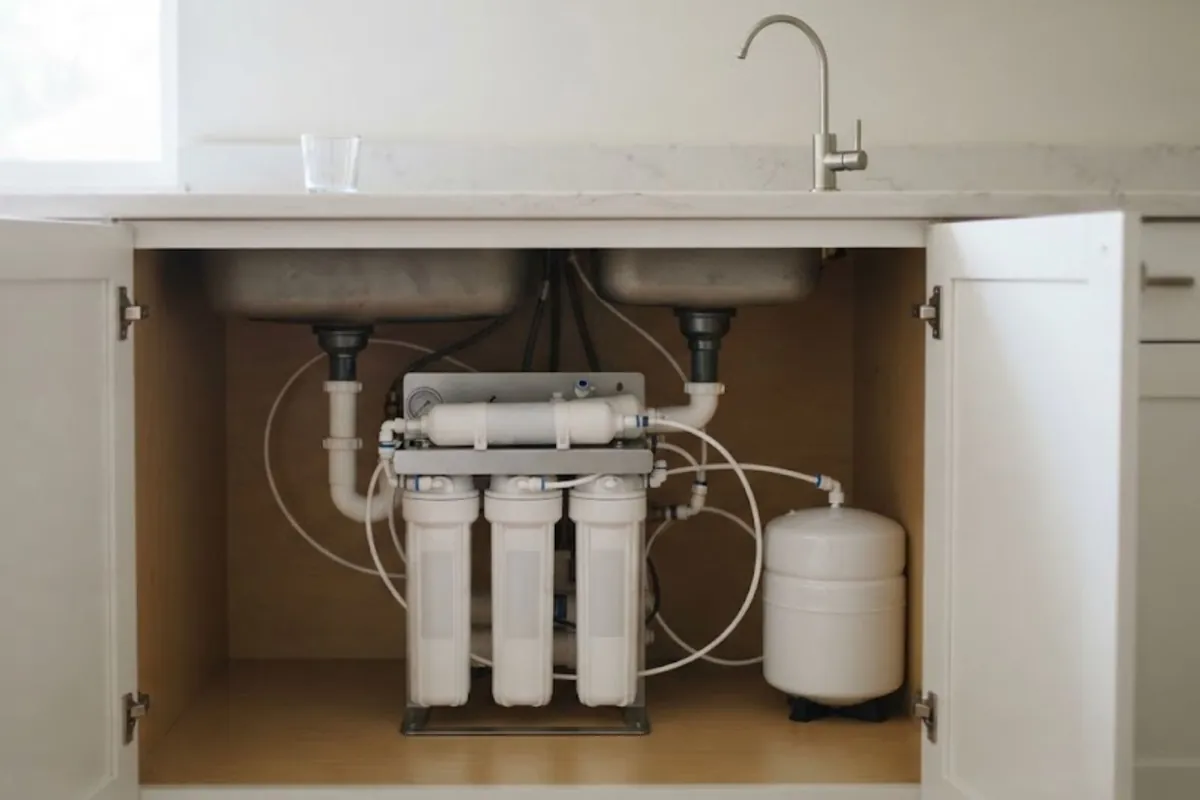
A reverse osmosis system under the kitchen sink treats the water you drink and cook with. It pushes water through a fine membrane that removes most dissolved minerals and many contaminants, and it stores the treated water in a small tank for a dedicated faucet.
A whole-house filter treats every tap. It is typically a carbon system that improves taste and odor throughout the home. It does not remove what reverse osmosis removes, and it does not soften water.
Many Meridian homes combine the two with a softener: a water softener to stop scale, and reverse osmosis at the kitchen for drinking water.
What a proper installation includes
Filtration is plumbing work, and it should be installed that way.
- A dedicated drinking water faucet and a drain connection with an air gap for reverse osmosis.
- Shutoff and bypass valves so the system can be serviced.
- Placement where filters can be reached for changes.
- Installation after the softener when both are used, to protect the membrane.
- A clear filter change schedule left with you.
Water conditioning equipment is permitted plumbing work in Idaho, and the plumber handles the permit where required.
Test before you buy
The city report shows system-wide results, not what comes out of your specific tap. A simple lab test of your own water, or a free city report review for your zone, keeps you from buying equipment for a problem you do not have.
If the goal is taste rather than a specific contaminant, a carbon filter is often enough and costs far less than reverse osmosis.
What affects the cost of water filtration
Filtration costs vary with the type of system and the plumbing needed.
- Reverse osmosis, whole-house carbon, or both.
- Space and drain access under the sink.
- Adding a refrigerator or ice maker line.
- Combining with a softener installation.
- Ongoing filter and membrane replacement.
Filtration installs come with a free estimate. Call (208) 679-8357 to set one up.
Want better drinking water in Meridian?
Call for a free estimate on a filter matched to your water.
Water filtration questions
Does Meridian water need to be filtered?
It meets federal drinking water standards. Filtration is a choice, often for taste or to reduce low levels of naturally occurring substances.
Will a water softener filter my water?
No. A softener removes hardness minerals. It does not remove arsenic, nitrate, or most other contaminants.
What does reverse osmosis remove?
Most dissolved minerals, including sodium, nitrate, fluoride, and arsenic, along with many other contaminants.
How often do filters need changing?
It depends on the system and water use. Reverse osmosis pre-filters are commonly changed every 6 to 12 months, and membranes less often.
Do I need a permit?
Water conditioning equipment is permitted plumbing work in Idaho. The plumber handles it.
I have a private well near Meridian. Can you help?
Yes, but well water should be tested first. City water reports do not apply to private wells.