Old Town Meridian Homes: A Guide to Galvanized Pipe and Cast Iron Drains
Homes built before about 1970, including many near Old Town Meridian along Main Street and Broadway, often still have galvanized steel water pipes and cast iron or clay drain and sewer lines. Galvanized pipe rusts from the inside and loses pressure, while clay and cast iron drains crack, corrode, and let roots in. Replacing them is usually a planned project, not an emergency, if you catch the signs early.
Meridian had only 2,616 residents in 1970, so homes this old are a small share of the city today. That makes them easy to overlook in advice written for newer subdivisions.
How to tell what your home has
You can often identify the materials yourself in a few minutes.
- Look at the pipes near the water heater or where the main enters. Gray, threaded steel pipe is galvanized.
- Scratch a supply pipe lightly with a key. Copper shows a penny color. Galvanized stays gray and a magnet sticks to it.
- Check the main drain stack. Heavy black pipe with bell-shaped joints is cast iron.
- Look at the sewer cleanout outside. A short clay or cast iron stub points to an original lateral.
- Check for mixed materials. Many older homes have a mix from earlier partial repairs.
What galvanized supply pipe does over time
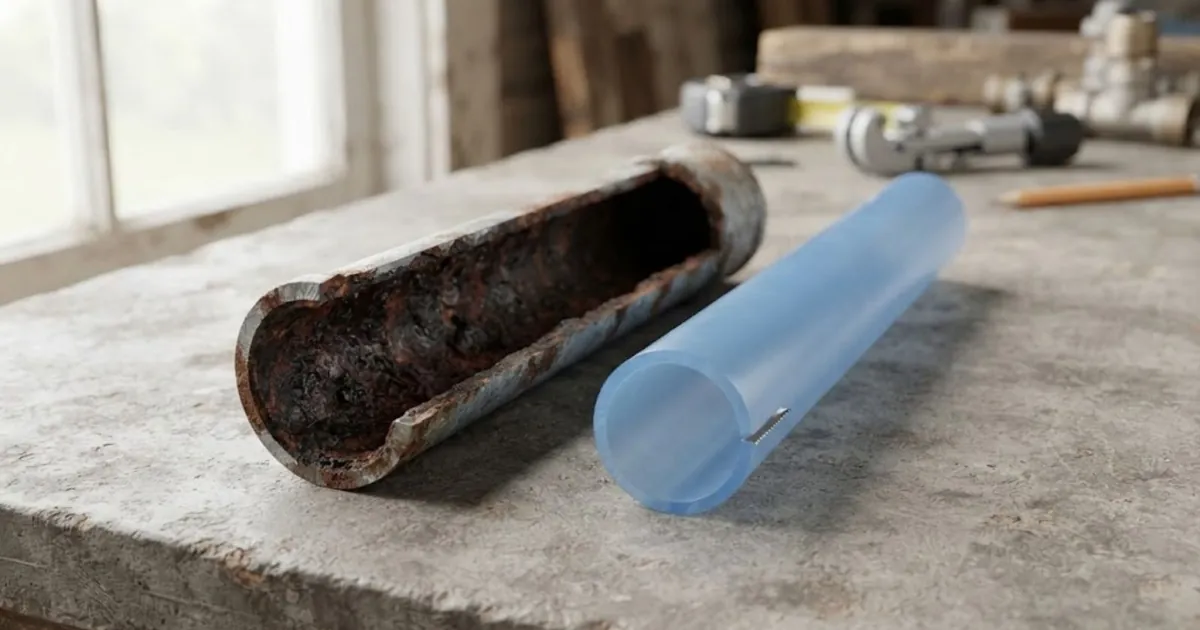
Galvanized pipe is steel coated with zinc. As the coating wears, the steel rusts from the inside. The rust builds up as a rough crust that narrows the pipe, which is why an older home can have strong pressure at one faucet and a weak trickle at another.
Hard water adds to it. Meridian's well water, 6.70 to 10.16 grains per gallon by zone in the city's 2024 report, lays scale on top of the rust, and the two together choke the pipe faster.
The usual signs are low pressure at several fixtures, brown water after the tap sits overnight, and leaks at threaded joints. Once galvanized starts leaking, it rarely stops at one spot.
What happens to cast iron and clay drains
Cast iron drain pipe corrodes from the inside, usually along the bottom where water runs. Over decades the bottom thins and can crack, leaving a channel that catches paper and waste. From the outside, the pipe can look fine.
Clay sewer pipe does not corrode, but its joints are short and many. Each joint is an opening for roots, and the mature trees on older Old Town lots find them. Roots then grow into a mesh that catches everything flowing past.
The result in both cases is the same: drains that clog repeatedly even after cleaning. A camera inspection is the only way to see which problem you have.
Planning replacement: what to do first
You do not have to replace everything at once. Order the work by risk and cost.
| Priority | Work | Why it comes here |
|---|---|---|
| First | Camera the sewer lateral | Roots and breaks cause the most disruptive failures. |
| Second | Replace failing lateral sections or the whole line | Stops repeat backups before they damage the house. |
| Third | Repipe galvanized supply lines | Restores pressure and ends recurring leaks. |
| Fourth | Replace interior cast iron as walls are opened | Easiest during remodels. |
A typical sequence for an older home. Your inspection results set the actual order.
When the lateral is failing along its whole length rather than at one spot, full sewer line replacement usually costs less over time than a string of spot repairs.
What a repipe looks like in an older home
Most repipes today use PEX, which bends around old framing and needs fewer fittings. Copper is also an option. In homes over a crawl space, much of the new piping can run underneath, with short runs up into walls at each fixture.
The job usually takes a few days, with water restored each evening. Our repiping service explains the process and offers a free estimate for planned work.
Practical warning signs in an older home
These signs tell you the original plumbing is near the end, whatever the house's exact age.
- Pressure drops when two fixtures run at once, such as a shower and a toilet refill.
- Brown or rusty water for the first few seconds each morning.
- A drip or crust at threaded joints under sinks or at the water heater.
- The same drain clogs more than twice a year.
- A sewer smell near the foundation or a floor drain.
Any one of these is worth a closer look. Two or more usually means it is time to plan replacement rather than keep repairing.
What waiting usually costs
Old supply pipe and old drains rarely fail all at once. They fail one joint at a time, and each repair costs a service call plus whatever the leak damaged. Over a few years, those calls can add up to a meaningful share of what a planned replacement would have cost.
Drain failures carry an extra risk. A sewer backup into a finished room is a contaminated water cleanup, and many insurance policies exclude it unless you added specific coverage.
Planning the work lets you schedule it, compare estimates, and combine it with other projects such as a bathroom remodel. It also avoids the premium that comes with emergency timing.
Combining plumbing with a remodel
The cheapest time to replace old pipe is when the walls are already open. A kitchen or bathroom remodel in an older home is the natural moment to swap galvanized supply lines and cast iron drains in that area.
Ask your remodel contractor to plan a plumbing inspection right after demolition, before new framing or drywall goes up. That is when replacement costs the least and causes the least disruption.
Older housing nearby follows the same pattern
The same materials and the same failures show up in Garden City, which grew earlier than most of the Treasure Valley and still has many homes from the 1950s through the 1970s. If you are comparing older homes in either area, the checklist above works the same way.
Older home plumbing questions
Does my older Meridian home have galvanized pipes?
If it was built before about 1970 and has not been repiped, it may. Gray threaded pipe that a magnet sticks to is galvanized.
Is galvanized pipe safe for drinking water?
Its main problems are rust, low pressure, and leaks. EPA guidance also notes galvanized pipe can collect lead from older upstream plumbing, which is one more reason owners replace it.
Do I have to replace everything at once?
No. Most owners start with the sewer lateral and then repipe supply lines as budget allows.
How do I know if roots are in my old sewer line?
Repeated clogs and roots on a cleaning cable are strong clues. A camera inspection confirms it.
Do older homes need permits for repiping?
Yes. Repiping is permitted work, and the plumber handles the permit and inspection.