Frost-Free Hydrants: Why They Still Burst in Meridian and the Hose Mistake Behind It
A frost-free hydrant, or frost-free hose bib, bursts when water is trapped inside it during a freeze. The most common cause by far is a garden hose left attached, which stops the valve body from draining. The split happens in winter, but you usually find out in spring, when water sprays inside the wall the first time you open the spigot.
Most Meridian homes have frost-free spigots, so this is one of the most common spring repairs in the area. Here is how they work and how to keep yours intact.
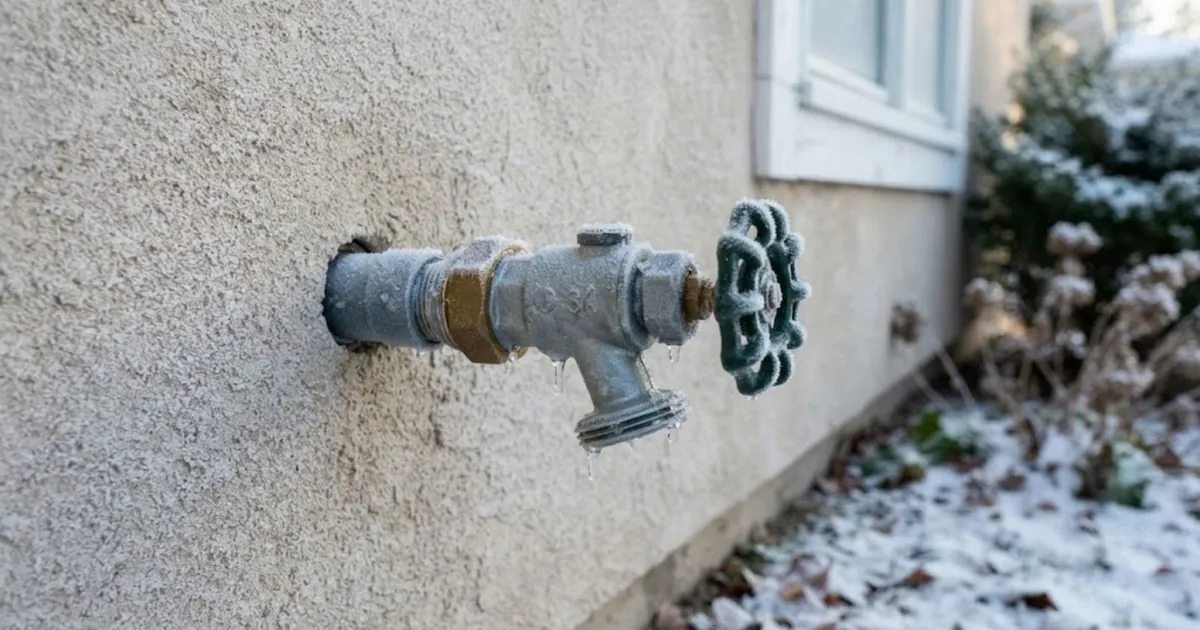
How a frost-free hydrant is supposed to work
A regular outdoor spigot closes right at the handle, outside the wall, where any water left in it can freeze. A frost-free version has a long stem, often 6 to 12 inches or more, and closes the valve deep inside the house where it stays warm.
When you shut it off, the water left in the long barrel between the valve and the spout is supposed to drain out through the spout. That only works if the spout is open to the air and the hydrant is installed with a slight downward slope toward the outside.
Remove either of those conditions and the barrel stays full. When the outdoor temperature drops, that water freezes, expands, and splits the barrel inside the wall.
Why they burst anyway
Almost every split frost-free hydrant traces back to one of these.
- A garden hose left connected through a freeze, trapping water in the barrel.
- A splitter, timer, or quick-connect fitting left on the spout, which has the same effect.
- A hydrant installed without enough slope, so water pools inside instead of draining.
- A worn vacuum breaker cap that does not let air in to help it drain.
- An older standard spigot that was never frost-free in the first place.
The fix for the first two is free: take everything off the spout before the first hard freeze and store the hose for winter.
How to tell if yours split over the winter
Because the break is inside the wall, the signs can be subtle. Check the first time you use each spigot in spring.
| What you notice | What it likely means | What to do |
|---|---|---|
| Water sprays or drips inside the wall or crawl space when the spigot is on | The barrel split inside the house | Turn it off and do not use it. |
| Weak flow outside while you hear water running | Water is escaping through the split | Turn it off and check the crawl space. |
| A wet spot on the inside wall or basement ceiling near the spigot | A slow leak from a crack | Shut off the line and inspect. |
| Water keeps dripping from the spout after shutoff | Worn washer or seat, not necessarily a split | A repair rather than a replacement. |
Common signs of a split frost-free hydrant.
If you suspect a split, look in the crawl space near where the spigot passes through the wall while someone opens it for a few seconds.
Repairing or replacing a split hydrant
A split barrel cannot be patched. The hydrant is replaced with a new one of the right length, installed with the proper slope, and connected to the supply line inside the wall or crawl space. Access is often easier in Meridian homes with crawl spaces, since the plumber can reach the connection from below.
If water sprayed inside the wall for any length of time, the drywall and insulation behind it may be wet. Small amounts dry out. Larger soaking needs attention before it turns into mold.
A dripping spout without a split is a simpler repair, usually a washer or seat. Our faucet and outdoor spigot repair service covers both.
Fall prevention for every spigot
Do this each fall, alongside the sprinkler blowout.
- Disconnect every hose, splitter, and timer from outdoor spigots.
- Open each spigot briefly after disconnecting to confirm water drains from the spout.
- Check that the vacuum breaker cap on the spigot is intact.
- Add a foam spigot cover for extra protection on north-facing walls.
- If you have older standard spigots, consider replacing them with frost-free models.
The same fall routine protects the pipes behind the wall. Our frozen pipe repair page has the full checklist for crawl space lines.
What a correct installation looks like
A frost-free hydrant only protects itself if it is the right length and set at the right angle. The valve seat has to sit inside the heated part of the house, beyond the wall insulation, and the barrel needs a slight downward pitch toward the outside so it drains.
When a hydrant is replaced, the plumber matches the length to the wall thickness and checks the slope before securing it. The spout should include a vacuum breaker, which lets air in so the barrel empties and also protects the house water from being siphoned back.
If your home has a hydrant that has split twice, the install itself may be the problem. A short barrel that stops inside the cold wall cavity or a hydrant pitched back toward the house will keep freezing no matter how careful you are with hoses.
When water got into the wall
A split hydrant usually sprays into the wall cavity or down into the crawl space before anyone notices. If you ran the spigot for a while before spotting the problem, check the inside of that wall and the area below it.
Damp drywall that dries within a day or two often needs nothing more than time and airflow. Insulation that stays wet, a musty smell, or staining that spreads are signs the area needs to be opened and dried properly before mold sets in.
More spigots, more risk
Homes on larger lots often have more outdoor spigots, sometimes on outbuildings or far corners of the yard. Every one is a potential split. In Kuna, where many newer homes sit on larger lots on the edge of town, it is worth walking the property each fall and checking every spigot, not just the one by the back door.
Frost-free hydrant questions
Why did my frost-free spigot burst?
Usually a hose or fitting was left attached through a freeze, trapping water in the barrel so it could not drain.
Can a split frost-free hydrant be repaired?
No. A split barrel means the hydrant has to be replaced.
Do I need to cover frost-free spigots?
It is not required if hoses are disconnected and the hydrant drains, but a foam cover adds protection on exposed walls.
How do I know if the barrel is split?
Open the spigot and check the crawl space or inside wall near it. Water there means a split.
Should I shut off the water to outdoor spigots in winter?
If your home has a separate shutoff for them, closing it and draining the line adds protection.